
Learn. Adapt. Outthink. Win.

Decision intelligence for complex environments

Axiomyx is a self-learning tactical decision engine built to reason through complex, adversarial environments. It combines learned neural evaluation with search and simulation to compare possible actions, measure outcomes, and improve through experience.

Self-play learningThe system improves by playing against itself rather than by following written tactics
Search and evaluationMonte Carlo Tree Search reads candidate lines forward against a learned position estimate
Publicly demonstratedMore than 80 player games recorded against real opponents at Nova Open 2026
A search tree over candidate actions A decision tree branching from a single current position into candidate actions and then into resulting positions, with one line through the tree highlighted as the action that was chosen.
Current position, candidate actions, measured outcomes

What Axiomyx is

A decision loop, not a rulebook.

Axiomyx does not follow tactics somebody wrote down. It reads the situation, works out which moves are worth examining, plays those moves forward to see where they lead, and chooses the one that measures best. Then it learns from what actually happened.

  1. 01State

    The environment supplies the situation: the current position, whose turn it is, which actions are legal, and what counts as winning.

  2. 02Evaluate

    A trained neural model scores the position and estimates which of the available actions are worth spending time on.

  3. 03Search

    Monte Carlo Tree Search plays promising lines forward, sampling how each one tends to turn out.

  4. 04Decide

    The action with the best measured outcome is selected and played, within the time the environment allows.

  5. 05Outcome

    What followed is recorded: the move, the position it produced, and eventually the result of the game.

  6. 06Learn

    Recorded games become training data. The evaluation improves, so the next search starts from a better estimate.

Step six feeds step one. Training runs on games the system plays against itself, so experience accumulates without needing a human on the other side of the table.


Three environments, one architecture

Where Axiomyx runs.

The same decision architecture is applied to different problems. What changes is the environment around it: what the state looks like, which actions are legal, and what a good outcome means.

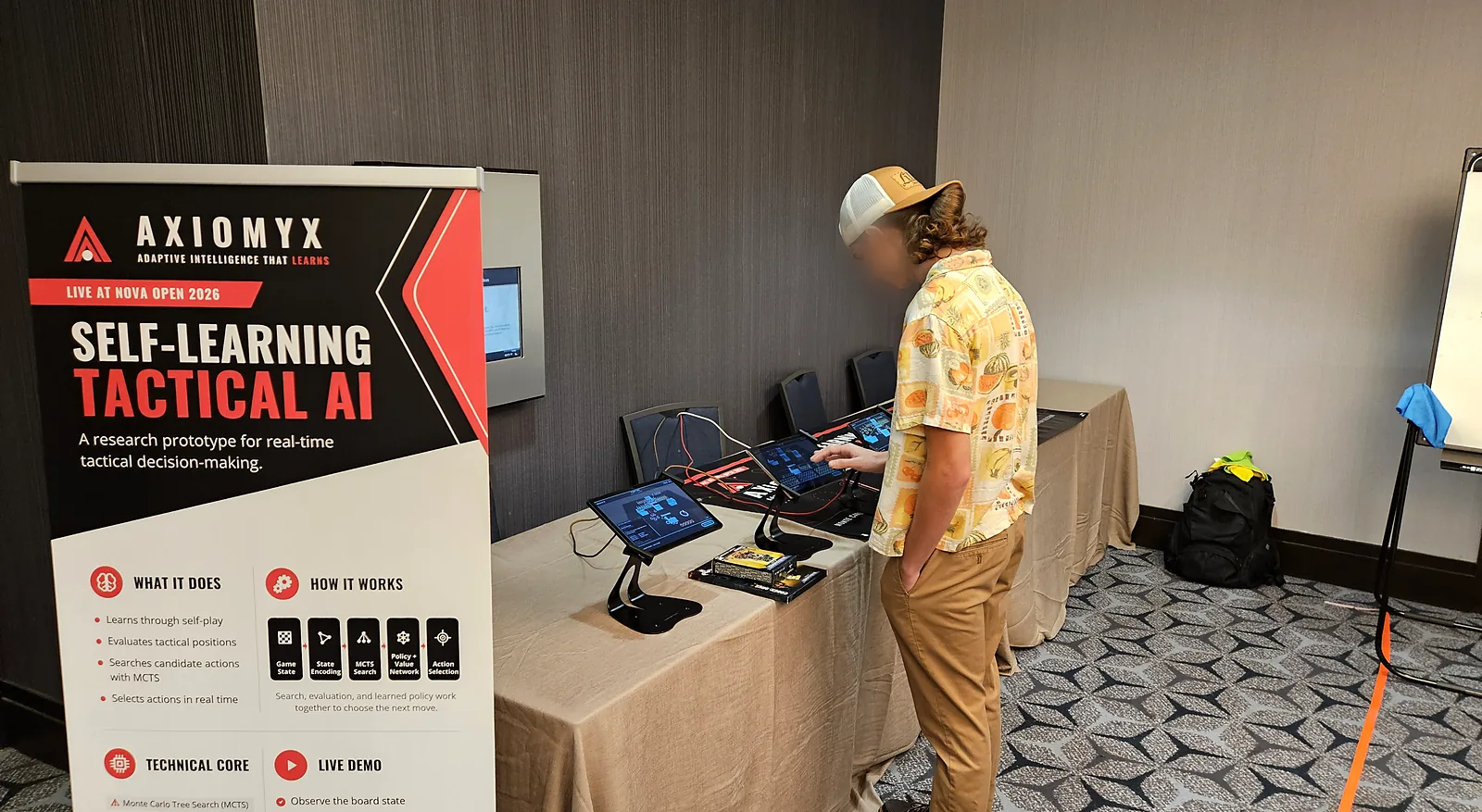
A player working through a match against Axiomyx on a booth tablet at Nova Open 2026.

Axiomyx Arena

A self-learning tactical opponent for complex games

The gaming-facing implementation of the platform. Arena puts an adaptive opponent into a structured game environment so players, clubs and coaches can practise, repeat difficult situations, and compare human decisions against machine ones.

  • Practice when another player is not available
  • Repeatable matchups and fixed tactical problems
  • Replay and after-action review of recorded games
  • Expert against machine comparison on the same position
Explore Arena
Branching courses of action One starting situation branching into several candidate courses of action, each ending at a differently weighted outcome.

Axiomyx Decision Lab

Human-machine experimentation for complex decisions

The same architecture applied to synthetic decision environments instead of competitive games. Build a scenario, introduce uncertainty, run candidate courses of action against an opponent that adapts, and compare how people and the system respond.

  • Wargaming, professional education and simulation
  • Course of action exploration and comparison
  • Adaptive opposition rather than a fixed script
  • Repeated experiments on the same starting situation
Explore Decision Lab
Environment and engine layers An upper layer supplied by the environment, covering state, legal actions, rules and objectives, sitting on a lower reusable engine layer covering evaluation, search, simulation, selection, training and telemetry.

Axiomyx Engine

The reusable decision architecture underneath Axiomyx

Arena and Decision Lab are two environments on one core. An environment defines its own state, legal actions, rules and objectives. The engine supplies encoding, learned policy and value, search, simulation, selection, training and telemetry.

  • State encoding and learned evaluation
  • Monte Carlo Tree Search over candidate actions
  • Self-play and training
  • Decision telemetry you can inspect afterwards
Explore the Engine

Nova Open 2026

Tested with real players.

Axiomyx spent Nova Open 2026 on a table in front of the people best placed to break it. Anyone could sit down and play a full game against the current build, and every game was recorded.

80+Recorded player games
~47Tactical decisions per completed game
~350 msAverage time to choose a move
700+MCTS simulations per game

Most players beat it. That is the honest result, and it is the more useful one: this was an active development build, not a finished commercial opponent. What mattered is that the agent could complete a complex game against a person without another human on the other side, and that players kept asking when they could have it as a practice opponent.

Read the case study
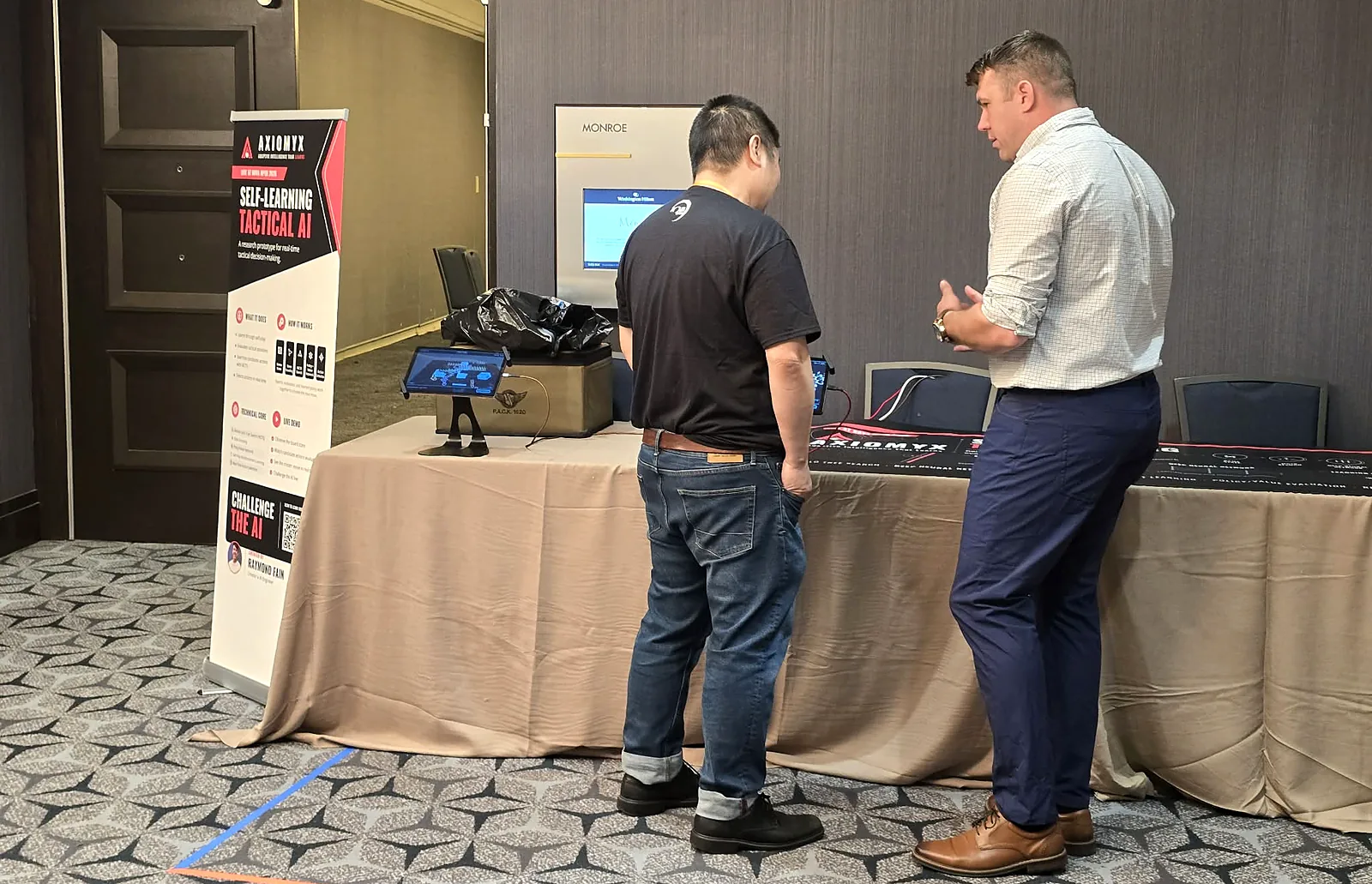
Raymond Fain talking a player through a move at the Axiomyx demonstration table at Nova Open 2026.
Talking a player through a move at the Axiomyx stand, Nova Open 2026.

Raymond Fain at the Axiomyx stand at Nova Open 2026, with the banner behind him showing the steps the system works through to choose a move.
Raymond Fain at the Axiomyx stand, Nova Open 2026.

Creator

Raymond Fain

Raymond Fain builds Axiomyx. He works in AI and machine learning and has spent more than seventeen years in leadership and operational roles in the U.S. Army. He started Axiomyx to find out how far a system can get by learning tactics from experience instead of being told them.

He wrote the decision engine, the training loop, the tablet client and the game archive behind this site, and he spent Nova Open 2026 standing next to it while strangers took it apart.

Axiomyx is an independent project. Nothing on this site represents the position of, or endorsement by, the U.S. Army or the Department of Defense.

AI and machine learning Reinforcement learning Search and simulation Strategy and wargaming

Register interest

Tell us which part you want.

Axiomyx is in active development. Registering tells us which environment you care about, and that is what decides what gets built next.

You will hear about demonstrations, development milestones and early access. Nothing else.